

On a superyacht transom, the difference between signage that reads as jewelry and signage that reads as hardware often comes down to two invisible processes: seamless welding and mirror polishing. When 316L letterforms are joined with visible beads, grind marks, or heat tint, even expensive metal looks like an afterthought. Whether you are specifying a new build, planning a yacht refit, or evaluating quotes from a shipyard sign supplier, understanding how premium fabricators achieve weld-free surfaces helps you inspect quality before letters ship—and before the first broker photo goes live.
Why Welds Show on Transoms (and Why That Matters)
Yacht names are photographed constantly: listing shots, charter marketing, guest social posts, and yard handover documentation. Transom lighting is rarely flattering to imperfect metal—harsh sun, water reflections, and wide-angle lenses all magnify surface inconsistency.
A visible weld line on a curved serif or a script return does not fail structurally on day one, but it signals fabrication shortcuts:
- Specular break: mirror faces throw continuous highlights; a weld zone scatters light differently and reads as a seam from the dock.
- Grain mismatch: on brushed programs, inconsistent direction around joints looks like a patch repair.
- Heat tint: blue or gold oxidation left on returns suggests incomplete passivation—a long-term corrosion concern in salt air.
- Optical competition with LED: halo and face-lit programs amplify any surface irregularity when light grazes letter edges at night.
Premium custom yacht sign programs treat every joint as a finish surface, not a hidden structural detail.
Seamless TIG Welding on 316L Letterforms
Most luxury metal yacht lettering is fabricated from 316L stainless steel—chosen for chloride resistance in marine environments. Complex wordmarks, crests, and illuminated channels rarely emerge from a single laser-cut blank; they require joints at returns, crossbars, interior counters, and mounting bosses.
TIG (GTAW) welding is the default for this work because it offers precise heat control, clean fusion, and compatibility with thin-gauge letter walls where MIG spatter would ruin a mirror program. The goal is not merely a strong joint—it is a joint that can disappear after blending and polishing.
Fabrication sequence (simplified)
- Precision cut and fit-up: laser or waterjet profiles with minimal gap before tacking—gap control reduces filler volume and grind time.
- Tack and sequence plan: welders distribute heat to limit distortion on thin returns and curved scripts.
- Low-heat TIG passes: matching 316L filler, argon shielding, and consistent travel speed to avoid burn-through on letter faces.
- Blend grinding: progressive removal of bead height without creating flat spots or radius breaks on curves.
- Passivation: acid or citric passivation to restore corrosion resistance after heat-affected zones.
Scripts with tight radii—common on classic yacht names—are where skill separates suppliers. A fabricator who can weld and blend an "S" or "R" return without flattening the curve preserves both structure and aesthetics.
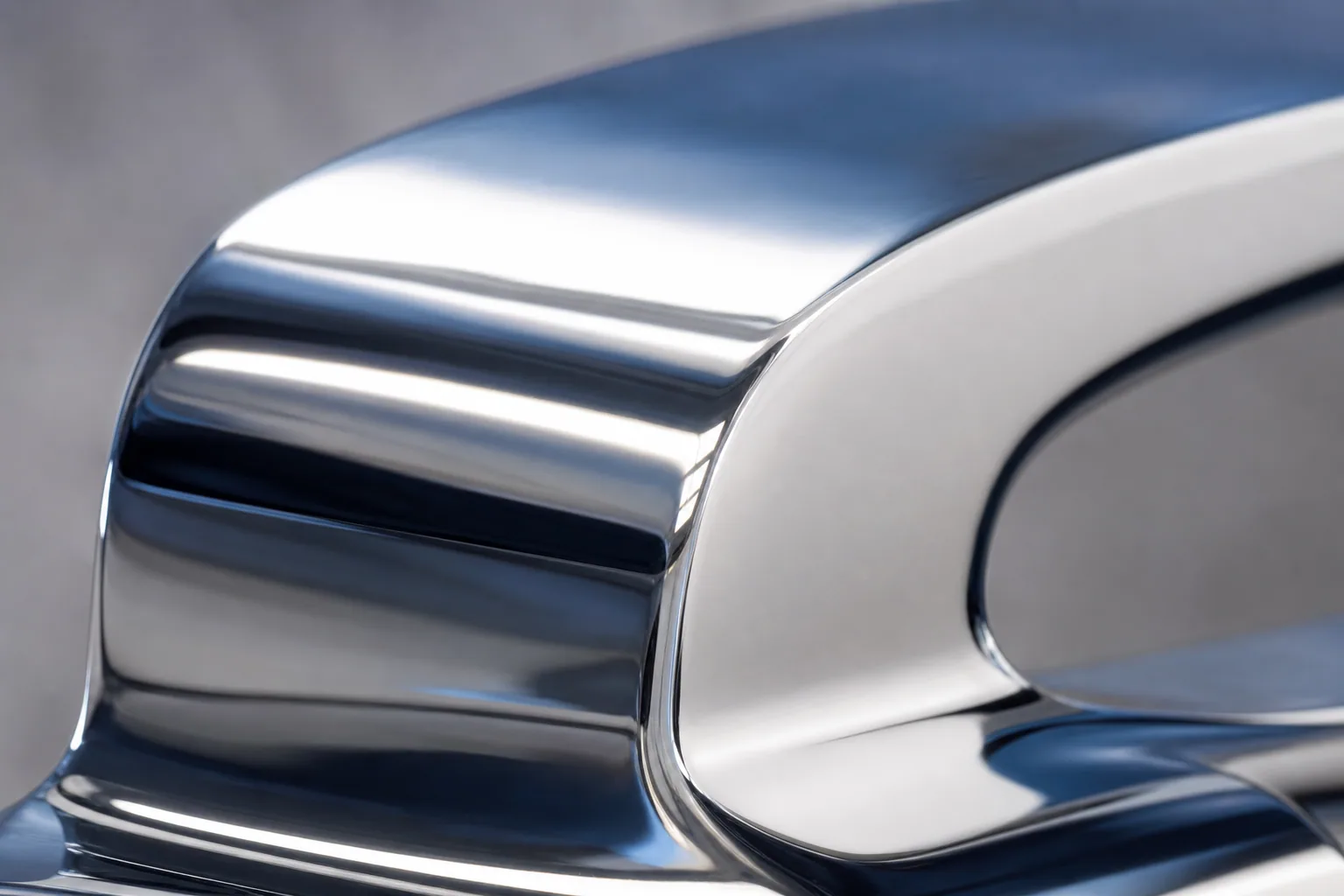
Invisible weld zones on mirror 316L — the joint should disappear under specular reflection. Mirror Stainless Steel.
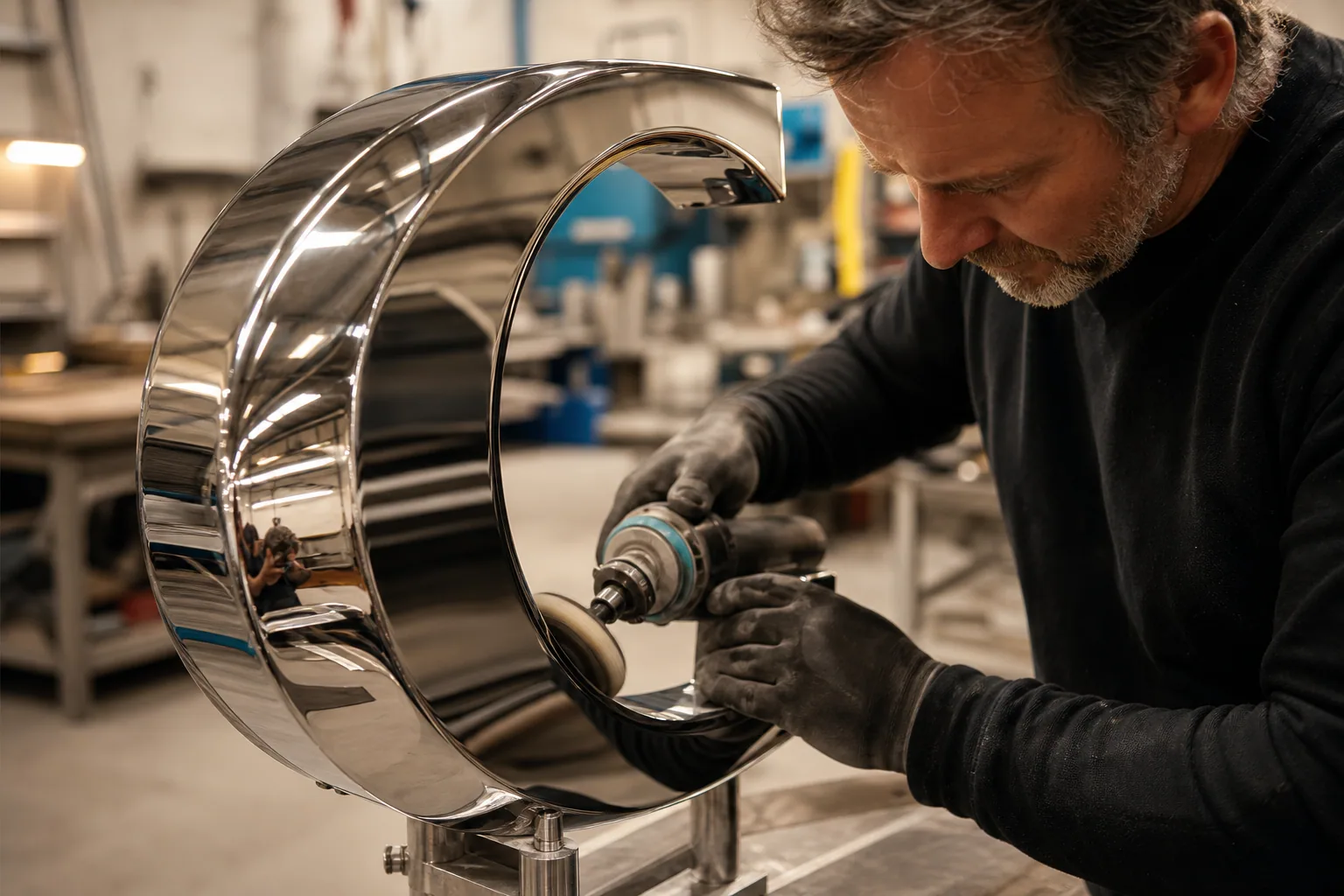
Mirror polishing after weld blending — progressive grits restore a uniform luxury finish. 316L Materials.
Mirror Polishing: The Second Half of "Seamless"
Welding and grinding alone cannot deliver the mirror transom look owners expect. Mirror polishing is a multi-stage abrasive process—typically coarse grind through fine compounds—followed by buffing to a specular Ra (roughness average) that reads as liquid metal in dock photos.
Critical discipline points:
- Whole-face consistency: polishing only the weld zone leaves a "halo" of different reflectivity; premium shops polish the entire visible face to one standard.
- Edge and return treatment: returns and letter backs may be brushed or satin even when faces are mirror—transitions must be crisp and intentional, not accidental.
- Curve preservation: over-polishing can round sharp typographic details; under-polishing leaves cloudiness that shows in direct sun.
- Pre-install protection: mirror faces ship with protective film; yards must respect peel timing relative to paint and fairing dust.
Compare finish behavior in mirror vs brushed 316L before you lock artwork. Mirror programs demand the highest weld discipline because there is nowhere to hide inconsistency.
Premium vs Budget: What to Look For
Two quotes can both say "316L stainless" and "mirror finish" while delivering very different transom presence. Use this inspection frame when reviewing supplier samples or QC photos:
| Inspection point | Premium signal | Budget warning sign |
|---|---|---|
| Weld visibility | No bead line visible on face or return at arm's length | Dark seam, porosity pits, or obvious grind flat on curves |
| Reflectivity | Continuous mirror reflection across joints and letter centers | Cloudy patches, orange peel texture, directional scratches |
| Heat tint | No blue/gold oxidation; passivation documented | Discolored returns or backs suggesting skipped passivation |
| Typography fidelity | Stroke weight and counters match approved vector art | Flattened curves, widened joints, or distorted interior spaces |
| Illuminated channels | Welded housings with blended exterior faces; sealed LED paths | Visible screws, cap plates, or unsightly overlaps on halo letters |
Request macro photos of the worst-case joints—interior counters, tight radii, and logo intersections—before approving shipment. Those frames predict how the name will behave in Caribbean midday sun, not only under workshop LEDs.
Structural Integrity and Marine Durability
Seamless appearance must never come at the cost of sound fusion. Cosmetic filler or body compound over voids creates failure paths when letters flex under vibration or thermal cycling on dark transoms.
Correct programs combine:
- Matching 316L filler metal to avoid galvanic or corrosion mismatch at joints.
- Full penetration or engineered fillet geometry appropriate to stud loads and letter span.
- Post-weld passivation to restore the chromium oxide layer after heat-affected zones.
- QC beyond visual: dimensional check against CAD, stud pattern verification, and continuity tests on illuminated assemblies.
Material context lives in best materials for yacht exterior signage and our 316L stainless steel overview. Alloy choice sets the ceiling; welding and polishing determine whether the finished sign reaches it.
Illuminated Letters: Welding Meets LED Architecture
Halo and face-lit programs add internal channels, standoff brackets, and cable exits that must be welded into the letter body without compromising optics or sealing. A seamless exterior face is harder when the back side carries LED modules, stud bosses, and gland paths.
Premium illuminated fabrication typically:
- Welds channel sections so exterior faces remain continuous—no visible cap screws on the transom plane.
- Plans weld sequence before LED routing so blend work does not damage sealed modules.
- Coordinates with marine-grade LED waterproofing requirements so polish and passivation do not compromise potting or glands.
If night identification matters, read LED yacht lettering for night approach and compare effects on illuminated yacht signage before weld drawings freeze.
Maintenance After Mirror Polish
Mirror-finished welded letters are stunning—and unforgiving of neglect. Salt film, fender scuffs, and early tea staining show quickly on specular faces. Crew maintenance does not re-weld, but it preserves the polish investment:
- Freshwater rinse after salt exposure; avoid abrasive pads on mirror faces.
- pH-neutral cleaners only; never steel wool on welded zones.
- Periodic inspection of stud seals and edges where crevice corrosion can start if deposits accumulate.
Full routines are in how to maintain stainless steel boat letters. Budget the polishing line item in yacht operating budgets for exterior signage when modeling lifecycle cost.
Spec Checklist for Owners and Shipyards
Add these lines to your refit folder or yard meeting notes:
- Alloy: 316L stainless, with filler class documented on drawings.
- Welding method: TIG; joint locations shown on fabrication drawings.
- Finish target: mirror polish or brushed with grain direction noted per character.
- Passivation requirement after final polish.
- QC deliverables: macro photos of weld zones, dimensional report vs approved artwork, stud pattern confirmation.
- Protective film policy through paint/fairing windows at the yard.
- For illuminated programs: channel weld strategy, LED sealing cross-reference, and driver location on electrical drawings.
Share transom photos and finish references from how it works early so weld and polish scope align with paint schedules—not the night before sea trials.
Review weld and polish standards for your next program.
FAQ
What is seamless welding in luxury yacht sign?
Seamless welding (often TIG on 316L stainless) joins letter segments, returns, and mounting features so the finished face shows no visible bead, undercut, or heat discoloration. The weld is ground, blended, and polished until it disappears into the surrounding mirror or brushed grain—critical for curved scripts and multi-piece logos where joints would otherwise catch light on the transom.
Why does mirror polishing matter after welding yacht letters?
Mirror polishing restores the specular finish that welding disrupts. Without progressive grit sequences and final buffing, weld zones appear cloudy or directional compared to the rest of the letterform—visible in dock photos and harsh midday sun. Premium programs polish the entire face to a uniform Ra value so reflections read continuous across curves and joints.
Can you see weld lines on budget yacht lettering?
Often yes. Lower-cost programs may leave visible beads on returns, skip full blending on interior curves, or polish only the front face while returns show heat tint. At close range those defects are obvious; from the dock they can appear as dark seams or inconsistent glare. Request weld-zone photos at QC before crating.
Does seamless welding affect corrosion resistance on marine signage?
Correct TIG on 316L with matching filler and full post-weld passivation preserves marine corrosion performance. Poor welds—wrong filler, porosity, or incomplete passivation—create crevice paths for chloride attack in salt spray. Seamless appearance should come from skilled fabrication, not filler compounds that hide structural defects.
What should shipyards specify for welded stainless yacht sign fabrication?
Document alloy grade (316L), welding method (TIG), filler class, joint locations on drawings, finish target (mirror vs brushed with grain direction), passivation requirement, and QC photos of weld zones before shipment. For illuminated programs, confirm LED channels and stud bosses are welded and blended without compromising seal surfaces.


