

A yacht name is only half the identity story. Many owners want the same marine-grade craft for a family crest, company logo, or personal totem—integrated into illuminated lettering so the stern reads as a complete marque, not letters alone. Custom logos on yachts succeed when emblems are engineered for stainless, salt, and night glow with the same discipline as the wordmark. Whether you are specifying a new build, planning a yacht refit, or aligning artwork with a shipyard sign supplier and naval architect specification, this guide shows how to integrate crests and emblems into your boat name without sacrificing legibility, waterproofing, or luxury proportion.
Why Crests and Emblems Belong on the Transom
From the dock, guests register silhouette first: name rhythm, then any mark that sits in the same visual system. A crest signals lineage and ceremony; a corporate mark signals charter or brand consistency; a totem signals private mythology—an animal, monogram, or motif that belongs only to that vessel.
- Identity beyond typography: letters name the yacht; emblems personalize it.
- Broker and charter photography: a coherent marque photographs as intentional design, not aftermarket decoration.
- Night presence: when the emblem shares the same sealed LED language as the letters, the whole composition holds together after sunset.
Treat the emblem as part of the same aesthetic brief as fonts and finishes—see matching yacht signs to boat aesthetics—so metal, polish, and glow feel inevitable on the hull. A durable custom yacht sign program starts with that identity brief, then translates paper artwork into forms that survive fabrication and seawater.
Family Crests: Heraldry That Survives Metal and Salt
Heraldic crests are emotionally powerful and technically demanding. Shields, beasts, and mottos that look crisp on stationery often collapse when stroke widths shrink to marine fabrication limits or when LED cavities need interior volume.
- Simplify for distance: marina viewers read bold silhouettes, not engraved micro-detail.
- Open the counters: closed loops and tiny charges fill with polish glare or vanish at dusk.
- One metal story: match crest finish to the name—mirror or brushed 316L—so the pair feels like one commission.
- Motto lines: if you include text under a shield, keep it secondary to the legal yacht name and hailing port hierarchy.
Expect a redraw step: a fabricator who understands illuminated stainless will rebuild your crest into cuttable paths while preserving the house character you care about. Pair that with type direction from classic script vs modern sans-serif so ceremony in the crest does not fight modernity in the letters—or vice versa.
Company Logos and Brand Marks on Private and Charter Yachts
Corporate and charter programs often need the vessel to carry a brand mark beside the registered name. The goal is recognition without turning the stern into a billboard.
- One-color silhouette: logos designed for multi-color screens must become a single stainless reading form (or a deliberate two-piece stack).
- Scale discipline: the logo should support the name, not overpower legal letter height.
- Charter photography: consistent marks across a fleet help guests and tenders identify the right vessel in crowded harbors.
- IP and approvals: confirm brand guidelines and trademark use before cutting metal—especially for managed or corporate fleets.
Modern geometric logos pair naturally with restrained sans lettering and cooler halos; heritage wordmarks often want warmer light and brushed grain. Browse current composition ideas in yacht signage design trends for 2026, then lock proportions against real transom photos—not only brand PDFs.
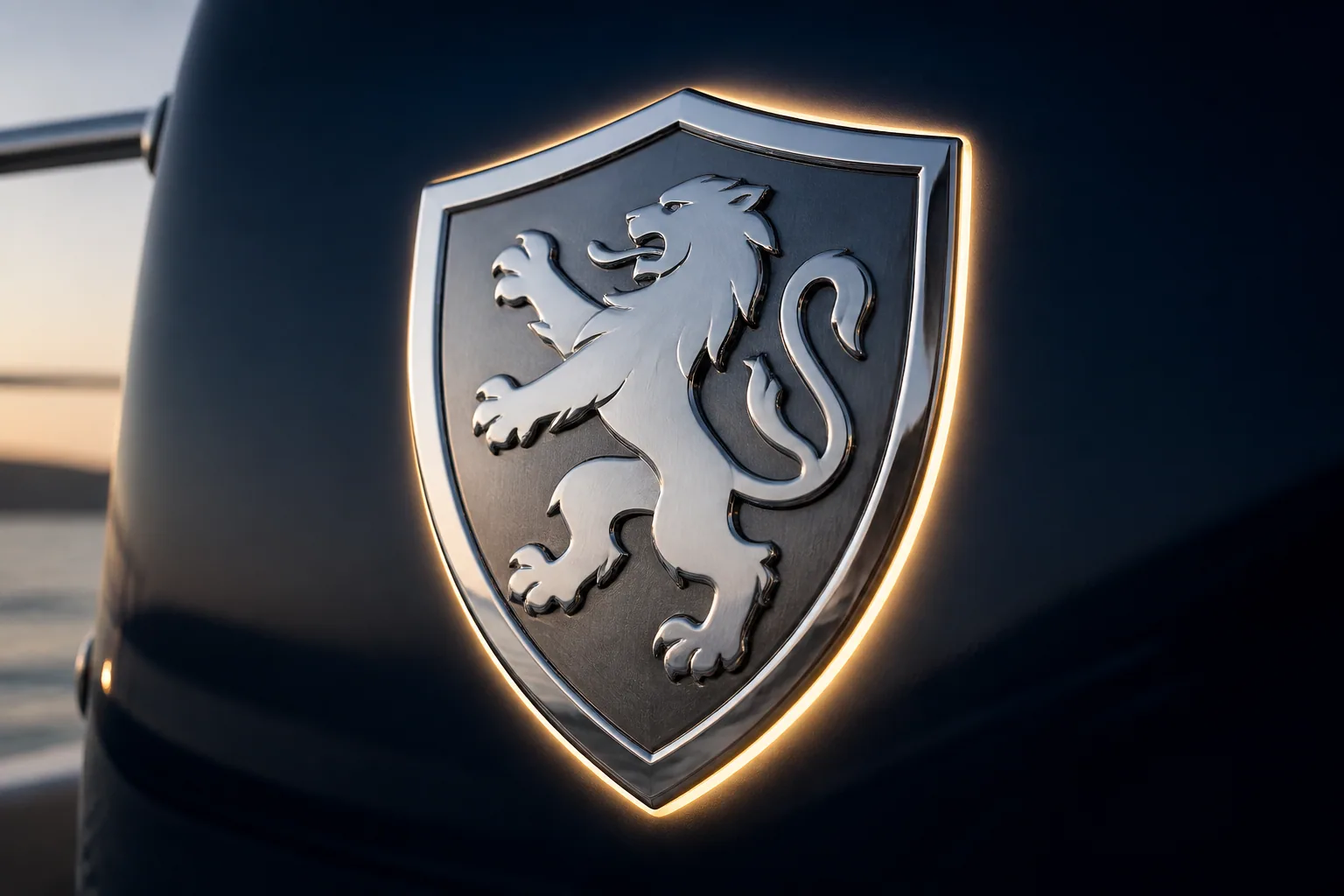
Simplified heraldic crest in marine stainless — bold enough for dock distance, sealed for night glow. 316L Materials.
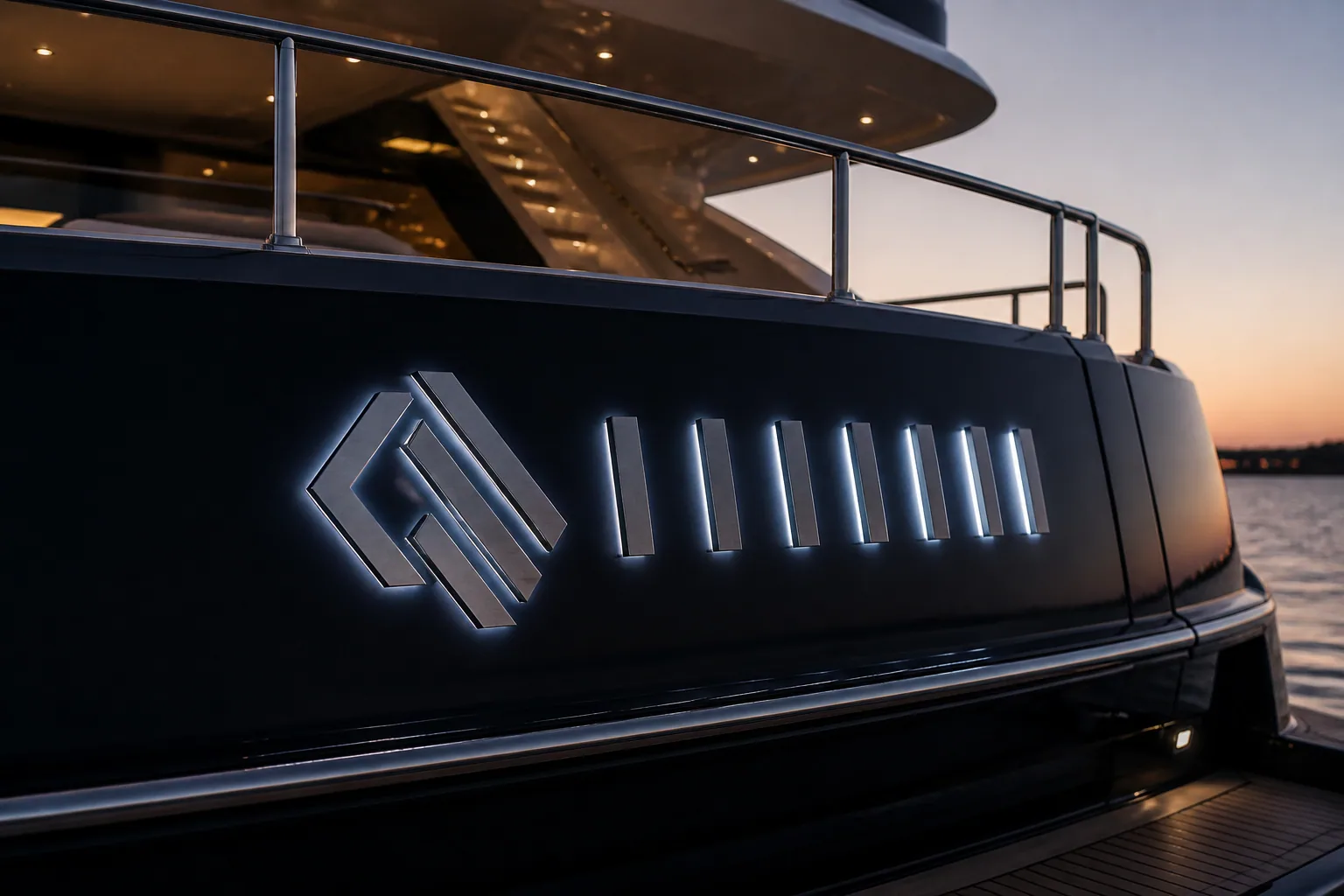
Brand mark beside the boat name — one metal story, shared LED language. Illuminated Yacht Signage.
Totems, Monograms, and Personal Motifs
Not every emblem is heraldic or corporate. Owners commission anchors, wave glyphs, animal silhouettes, intertwined initials, or private symbols that only the family recognizes—then ask for the same marine illumination as the lettering.
- Totem clarity: choose a motif that reads in pure silhouette at twenty meters.
- Monogram geometry: overlapping initials need generous joins and open counters once they become three-dimensional metal.
- Cultural and private marks: keep detail intentional; avoid fragile filigree that traps salt or refuses a clean polish.
Personal motifs work best when they share standoff depth, stud pattern language, and lighting CCT with the name—see lighting options—so the composition feels designed as one system rather than two products bolted nearby.
How Emblems Integrate With Illuminated Boat Names
Fabricators typically use one of four integration patterns for custom logos on yachts. Choose based on story, legal name clarity, and available transom real estate:
| Integration style | Best for | Watch-outs |
|---|---|---|
| Companion emblem | Most luxury programs; crest beside or above the name | Keep clear air between mark and letters; balance left/right mass |
| Centered marque | Symmetrical sterns; shield above a short name | Do not crowd legal height; watch swim-platform sightlines |
| Inline icon | Simple glyphs between word groups | Complex logos rarely fit inline without hurting readability |
| Shared halo field | Name + emblem on one visual plane at night | LED density and diffusion must match across both forms |
Illumination should match the letter package—warm or cool single-color LED, or coordinated RGB light show scenes—so the crest does not glow a different color temperature than the name. Waterproofing, potting, and stud penetrations follow the same marine rules as letter modules.
Ready to integrate a crest or logo into your illuminated boat name?
Artwork-to-Metal: What Makes Emblems Fabrication-Ready
Paper and screen logos are not cutting files. Before a shipyard sign supplier can laser, weld, and polish, artwork must become closed vector paths with marine minimums:
- Vector paths: SVG/AI/EPS with true outlines; flatten live effects and remove embedded bitmaps.
- Stroke floor: set a minimum metal thickness so joins survive grinding, polish, and vibration.
- LED cavities: if the emblem is illuminated, interior volume and diffuser retention must be designed—not hoped for after the silhouette is frozen.
- Seamless joins: complex crests need the same weld discipline as letter returns so beads disappear under mirror or brush finish.
- Proofing: approve full-size paper or vinyl mockups on the actual hull color before metal is cut.
Share files early through how it works so redraw time sits inside the refit schedule—not after paint dates freeze.
Spec Checklist for Owners, Captains, and Yards
Add these lines to the identity brief before fabrication:
- Emblem type: family crest / company logo / totem / monogram — and one-sentence meaning.
- Integration pattern: companion, centered, inline, or shared halo field.
- Vector artwork plus a simplified one-color silhouette approved by the owner or brand team.
- Finish match to the boat name (mirror or brushed 316L) and hull contrast photos.
- Lighting intent and CCT shared with the lettering package; confirm sealing approach.
- Scale relative to legal name height; confirm the mark never obscures mandated characters—see legal requirements for yacht names.
- Mounting notes, stud pattern, and cable path if illuminated; fitting context via yacht sign fitting.
- Lead time for redraw + fabrication aligned with yard milestones—see refit yard timing.
When crest, logo, or totem is specified with the same rigor as the wordmark, the stern reads as a complete luxury marque—day and night.
FAQ
Can a family crest or company logo be illuminated like yacht name letters?
Yes. Crests and emblems can be fabricated as sealed 316L stainless forms with the same marine LED packages used for lettering—halo, face-lit, or rear-diffused. The artwork must be simplified for metal and light: thin lines, tiny counters, and multi-color print effects rarely survive fabrication. Approve a full-size layout proof against the real transom before cutting.
Should the crest sit beside the yacht name or replace a letter?
Most luxury programs place a companion emblem beside or centered above the name so letterforms stay fully legible for dock recognition and marking rules. Integrating a logo into a letter can look clever in CAD but often weakens readability. Keep the legal name clear, then treat the crest as a supporting identity mark at a controlled scale.
What artwork files do you need for a custom yacht emblem?
Vector artwork is ideal—SVG, AI, or clean EPS with true paths, not embedded rasters. Provide a one-color silhouette version plus any required detail layers. High-resolution PNG can start a redraw, but marine fabrication needs closed paths, minimum stroke widths, and simplified heraldry before laser cutting and welding.
Will a complex heraldic crest work on a yacht transom?
Often only after simplification. Fine hatching, tiny charges, and multi-metal color fills that work on paper become muddy at marina distance and fragile in stainless. A skilled fabricator rebuilds the crest into bold silhouettes, open counters, and stroke weights that hold polish and optional LED cavities while still reading as your house mark.
Do custom logos affect yacht name legal marking requirements?
Emblems are decorative identity—they do not replace the vessel name or hailing port where flag rules require them. Keep the primary name clearly legible at the required height and contrast; size and place the crest so it never crowds or obscures mandated characters. When in doubt, confirm with your flag documentation rules and surveyor before final layout.


