

When a yacht changes name or home port, the legal marking rules are easy to overlook until a surveyor, broker, or boarding officer asks why the letters are too small, poorly contrasted, or missing from the required locations. Legal requirements for yacht names and ports of registry sit with the flag state—not with a classification society brochure—yet owners, captains, and yacht refit teams still need a practical reading of what “clearly legible,” “durable,” and “clearly visible” mean on a real transom. This guide summarizes U.S. Coast Guard documentation marking under 46 CFR § 67.123, compares UK carving-and-marking practice often encountered alongside Lloyd’s Register class programs, and translates those rules into fabrication specs your shipyard sign supplier or naval architect specification can actually use.
Flag State Rules vs Classification Society Expectations
Two systems get confused on refit kickoff calls:
- Flag-state registration (for example, U.S. Coast Guard vessel documentation or UK Ship Register carving and marking) creates the legal duty to display the vessel name and hailing port / port of choice.
- Classification societies such as Lloyd’s Register (LR), ABS, DNV, or Bureau Veritas set technical class standards for structure, systems, and surveys. They do not replace flag marking statutes.
On many UK-flagged or dual-attention programs, an LR surveyor may witness or review carving-and-marking completion as part of registration paperwork—but the letter-height and contrast rules still come from the Merchant Shipping regulations (or the applicable flag), not from “Lloyd’s lettering rules.” Treat class and flag as parallel checklists: class keeps the yacht in survey; flag keeps the name legally marked. For fabrication quality that survives both, start with a durable custom yacht sign program rather than temporary vinyl that fades before the next certificate renewal.
USCG Documented Vessels: 46 CFR § 67.123 Essentials
For U.S. federally documented vessels, the controlling text is 46 CFR § 67.123 — Name and hailing port marking requirements. Key operational points for owners and yards:
- Minimum height: letters must be not less than four inches (≈10.2 cm) in height.
- Character set: clearly legible letters of the Latin alphabet, or Arabic or Roman numerals.
- Durability: markings may use any means and materials that produce durable results—metal letters, carved plates, and quality painted marks can all qualify when they remain legible in service.
- Visibility: placement must be on a clearly visible exterior part of the hull as required for the vessel type.
Placement depends on how the vessel is documented:
- Recreational vessels documented exclusively for recreation: the name and hailing port must be marked together on some clearly visible exterior part of the hull (typically the transom for yachts).
- Other documented vessels (general rule): the name on the port and starboard bow and the stern; the hailing port on the stern.
- Square-bow vessels: name marked on a clearly visible exterior part of the bow so it will not be obliterated; name and hailing port on the stern.
Disputes over permanence, durability, legibility, or placement can ultimately be decided by the OCMI for the vessel’s operating zone (46 CFR § 67.125). Design for unambiguous compliance—do not rely on arguing a stylish but hard-to-read script after delivery.
What “Clearly Legible” Means for Yacht Lettering Design
The CFR does not prescribe a typeface, stroke width, or contrast ratio. In practice, boarding officers and surveyors judge whether a stranger can read the name and port under normal daylight at a reasonable distance. When specifying mirror stainless steel or brushed programs, keep these fabrication cues in the brief:
- Height floor is not a design target: four inches is the legal minimum for documented U.S. vessels—not the ideal size for harbor visibility. Many yachts run larger primary names for dock recognition (see busy-season transom visibility).
- Stroke weight: ultra-thin fashion fonts can fail the “clearly legible” test even when they measure four inches tall.
- Contrast: dark letters on dark gelcoat, or pale letters on pale topsides, create compliance risk regardless of material cost.
- Script vs sans: ornate scripts need generous counters and spacing; if the name is long, a cleaner sans or restrained serif often reads more reliably from the dock.
- Hailing port hierarchy: the port line is usually smaller than the name, but both must meet the four-inch floor when they are the required documented markings.
If night identification matters for charter or Med stern-to berthing, pair compliant daytime marks with planned glow from illuminated yacht signage—illumination helps operations, but it does not replace durable daytime lettering.
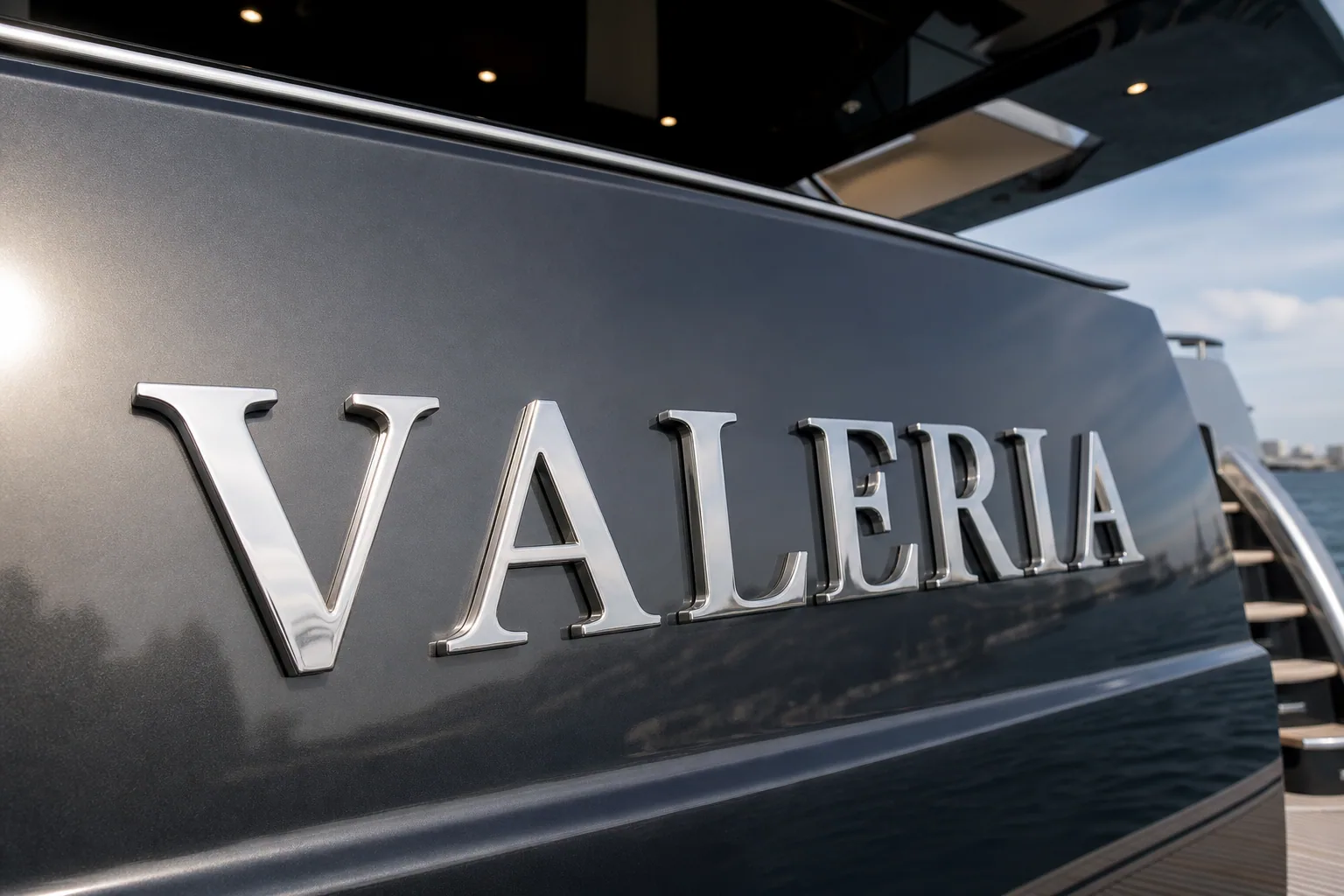
Legibility is stroke, contrast, and height—not only a four-inch caliper reading. Mirror Stainless Steel.
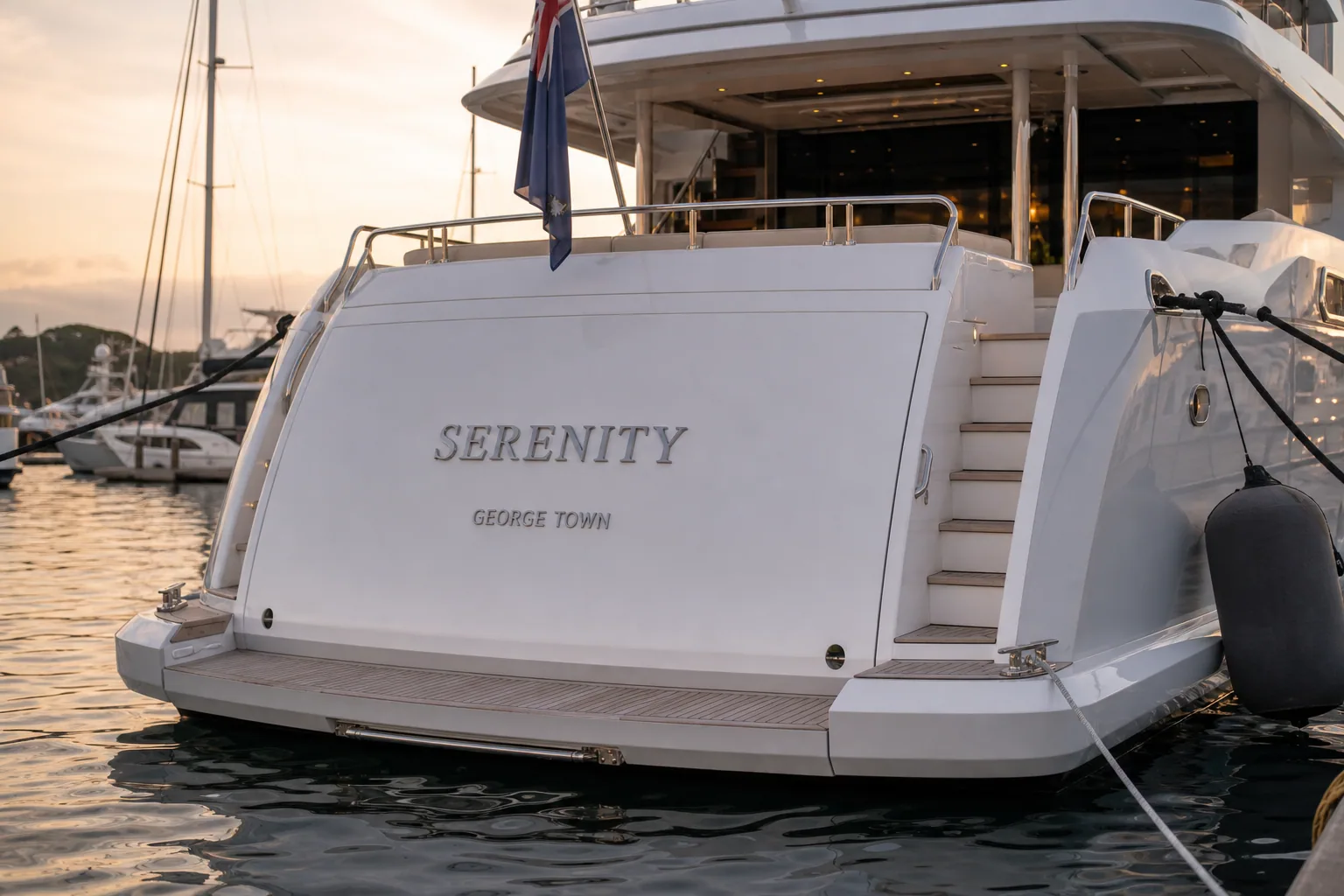
Name and hailing port marked together on a clearly visible stern plane—typical recreational documentation layout. Custom Yacht Signage.
UK Port of Registry Marking (and Where Lloyd’s Register Fits)
UK-registered ships follow carving-and-marking requirements under the Merchant Shipping (Registration of Ships) Regulations 1993, Schedule 3—not a Lloyd’s Register “font code.” Practical size and contrast rules owners encounter:
- Ships other than fishing vessels and pleasure vessels under 24 m: name on each bow; name and port of choice on the stern; white or yellow letters on a dark ground (or black on a light ground); letters not less than 10 cm high and of proportional breadth.
- Pleasure vessels under 24 m: name and port of choice on a conspicuous permanent part of the stern; same contrast convention; letters not less than 5 cm high (with approved alternative plate or GRP letter methods where needed).
- Character set: Roman letters for the name; Roman or Arabic numerals.
Lloyd’s Register commonly appears in the same project folder because LR class and UK registration surveys often run in parallel on larger yachts. Surveyors may confirm that carving and marking were completed to the Registrar’s satisfaction, but owners should still quote the statutory heights and contrast rules in the signage package—not “per LR class.” When a program is dual-flagged, reflagging, or moving between U.S. documentation and a Red Ensign registry, rebuild the marking matrix before artwork freezes.
USCG vs UK Marking: Quick Comparison
Use this side-by-side when a yacht refit brief involves both U.S. documentation language and UK registry language:
| Requirement | USCG documented (46 CFR § 67.123) | UK registry (MS Regs Sch. 3) |
|---|---|---|
| Minimum letter height | 4 inches (≈10.2 cm) | 10 cm (most ships); 5 cm (pleasure vessels <24 m) |
| Name placement | Recreational: with hailing port on hull; others: bows + stern | Bows + stern (most ships); stern for pleasure vessels <24 m |
| Port marking | Hailing port on stern (or with name for recreational) | Port of choice on stern |
| Contrast rule | Clearly legible (no prescribed color pair) | White/yellow on dark or black on light |
| Alphabet | Latin letters; Arabic or Roman numerals | Roman letters; Roman or Arabic numerals |
For visibility beyond the legal floor—especially in crowded Caribbean seasons—pair compliance with the practical cues in Caribbean yacht name visibility and charter handover notes in bareboat charter hull names.
Materials That Stay Durable Under Inspection
Both U.S. and UK frameworks emphasize permanence and durability. Vinyl that peels at the corners, paint that chalks after one season, or soft metals that tea-stain into illegibility create compliance and insurance headaches. Marine programs typically specify:
- 316L stainless letter bodies for chloride resistance—see best materials for yacht exterior signage and 316L materials.
- Stud-mount systems with marine sealant so letters cannot silently migrate or fall off after a hard berthing season—review yacht sign fitting.
- Finish choices that preserve contrast: mirror on dark hulls, brushed where glare or light topsides demand softer specular behavior (mirror vs brushed).
- Optional LED layers for night approach without relying on glow as the only identification method (LED yacht lettering for night approach).
If letters are illuminated, waterproofing and penetration sealing still matter for long-term legibility of the physical forms—see marine-grade LED waterproofing.
Spec Checklist for Captains, Owners, and Shipyards
Add these lines to the refit folder or naval architect specification before templates are cut:
- Flag / documentation status (USCG recreational documentation, commercial documentation, UK Part I / SSR, other Red Ensign, or state registration).
- Required marking locations (stern only vs bows + stern).
- Minimum legal letter height for name and for port / hailing port—then any larger aesthetic height for the primary wordmark.
- Contrast strategy against actual hull color (photo references under midday sun).
- Typeface constraints: no ultra-thin strokes; scripts approved only if counters remain open at full size.
- Material and mounting: 316L, finish, stud pattern, sealant class, and QC photos before crating.
- Lead time alignment with paint and sea trials—see refit yard timing for custom lettering.
State-registered (undocumented) U.S. recreational boats follow state numbering display rules that differ from federal documentation name marking—confirm with the issuing state before you assume the four-inch CFR rule applies. When in doubt, have maritime counsel or the documentation agent review the marking plan; this article is operational guidance, not legal advice.
Need compliant name and port lettering sized for your flag and hull?
FAQ
What is the minimum letter height for a USCG documented yacht name?
Under 46 CFR § 67.123, name and hailing port markings on U.S. documented vessels must be in clearly legible Latin alphabet letters (or Arabic or Roman numerals) not less than four inches in height. Many yachts specify larger primary names for dock visibility while keeping the port line at or above the legal floor.
Where must the name and hailing port appear on a recreational documented vessel?
For vessels documented exclusively for recreation, 46 CFR § 67.123 requires the name and hailing port to be marked together on some clearly visible exterior part of the hull—commonly the transom on yachts. Other documented vessels generally require the name on both bows and the stern, with the hailing port on the stern.
Does Lloyd's Register set yacht name lettering size requirements?
No. Lloyd's Register is a classification society; letter height and port marking rules come from the vessel's flag-state registry. UK-registered yachts follow Merchant Shipping carving-and-marking regulations (for example, 10 cm or 5 cm minimums depending on vessel class). LR surveyors may review marking completion during registration or survey workflows, but they do not create a separate LR font-size code.
Can illuminated stainless letters satisfy name marking regulations?
Yes, when the physical letters meet durability, height, alphabet, placement, and legibility requirements in daylight without relying on the LEDs. Illumination is an operational and aesthetic layer—it does not replace the requirement for clearly legible durable markings. Specify marine-grade sealing if you add halo or face-lit systems.
What should a shipyard specify for compliant yacht name lettering?
Document flag status, required locations, minimum legal heights for name and port, contrast against hull color, approved typeface constraints, 316L material and finish, stud-mount and sealant details, and QC photos before shipment. Align fabrication lead time with paint and sea-trial schedules so markings are complete before documentation or carving-and-marking sign-off.


